
ByJohn A
By the Numbers: The Seven-Question Audit I Run Before Buying Any Peptide
Here’s the number that opens this column: seven. That’s how many questions I ask a peptide provider before my card comes out, and by the end of this piece you’ll be able to score any provider against them yourself, including the ones I score below. Most buyers do the opposite of what the data rewards. They spend an hour comparing prices and about ninety seconds on the one thing that actually determines outcomes: whether anyone qualified is reviewing what they’re about to inject. Wrong order. This piece fixes that order. Science first, since you can’t grade an answer if you don’t know what a correct one sounds like. Providers last, scored against a checklist rather than vibes.
One name needs a fair hearing up front, because it drives most of the “alternatives” searches that land here: Biotech Peptides. It’s a real, US-based research-chemical supplier, and to its credit it doesn’t dress up what it is. Its own site states plainly that “all products are sold for research, laboratory, or analytical purposes only, and are not for human consumption,” and that it is “a chemical supplier…not a compounding pharmacy or chemical compounding facility” [1]. Respect the honesty. Then read the sentence for what it implies: there’s no one on the other end to ask any of my seven questions to, because there’s no clinician, no prescription, and no follow-up loop. That single quote answers question one and question two before you’ve even asked them. The rest of this column is for readers who want a provider they can actually cross-examine.
The number that matters most: 1 out of 36
If you remember one figure from this entire guide, make it this one. A 2025 systematic review in the HSS Journal pulled 36 studies on BPC-157, arguably the most-searched peptide on every one of these sites. Result: 35 were preclinical (animal or in-vitro), and exactly one was a small clinical study, 12 patients. The review’s conclusion: “no clinical safety data were found” [5]. A separate 2025 narrative review in Current Reviews in Musculoskeletal Medicine landed in the same place, calling human data “extremely limited” and the compound “should be considered investigational” [6].
Run that math against the marketing. If a page selling you BPC-157 calls it “proven” or “clinically established,” you now have a concrete number to hold it against: 1 out of 36. That gap between the claim and the count is the fastest tell I know for separating a straight shooter from a sales page.
The comparison the marketing skips: evidence tiers aren’t flat
Not every peptide sits at 1-out-of-36. Semaglutide and tirzepatide, both GLP-1 receptor agonists working through the incretin system to suppress glucagon, slow gastric emptying, and raise satiety [9], carry some of the largest randomized trials in the metabolic-health literature. In SURMOUNT-1, tirzepatide produced mean body-weight reductions ranging from 15.0% up to 20.9% across doses at 72 weeks, against 3.1% on placebo [7]. Retatrutide, still investigational, not approved, so treat that number as a research finding rather than a promise, produced a mean 17.5% reduction at 24 weeks in its Phase 2 trial [8].
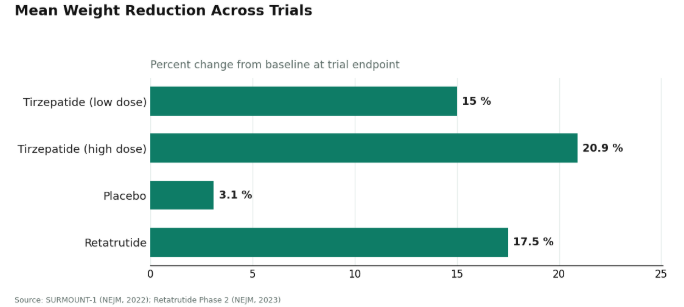
Here’s the comparison that actually matters for your decision, not just your curiosity: the compounds with the strongest efficacy numbers are also the ones with the most serious warnings attached, and that’s not a coincidence, it’s what real pharmacological activity looks like. Semaglutide carries a boxed warning for thyroid C-cell tumors and is contraindicated if you or your family have a history of medullary thyroid carcinoma or MEN 2 [10]. A compound that moves the needle 15 to 20 points on body weight is also a compound that needs someone checking your family history before you start. A vial with no clinician attached checks nothing.
The caveat: “research use only” is not a technicality, it’s a liability transfer
One more figure to sit with before you shop: zero. That’s roughly the regulatory review a “research use only” injectable receives before it reaches your doorstep. In 2026 the FDA made that explicit rather than implicit. On March 31, 2026, it told the seller Gram Peptides that products it offered, including retatrutide and tirzepatide, are unapproved new drugs under section 505(a), and that under section 201(g)(1) a product is classified as a “drug” by intended use read from context, label notwithstanding [2]. Prime Sciences got the same letter, same day [3]. Separately, the agency warned 30 telehealth companies over illegal marketing of compounded GLP-1 products [4]. None of those three actions name Biotech Peptides specifically, and I’m not implying one. The lesson generalizes regardless: a research chemical you inject has not been checked for identity, strength, or purity, and no one holds recall authority over it. The disclaimer protects the seller’s legal position. It does nothing for yours.
The scorecard: seven questions, scored yes/no
Here’s the checklist, turned into something you can actually grade a provider against instead of trusting a gut read.
| # | Question | What a passing answer sounds like |
|---|---|---|
| 1 | Does a licensed clinician review your history before anything ships? | Clear yes, real intake, not a checkbox |
| 2 | Does a licensed pharmacy dispense under recognized compounding standards? | Names a pharmacy, cites a standard |
| 3 | Is this compound approved, compounded, or research-only, for you specifically? | States it plainly, no blending of categories |
| 4 | What does the human evidence actually show for this compound? | Matches the tiers above: strong for GLP-1s, thin for BPC-157 [5][6] |
| 5 | What are your specific contraindications? | Raises them unprompted (e.g., thyroid history for semaglutide [10]) |
| 6 | What’s the follow-up plan? | A path back to a clinician, not a one-way shipment |
| 7 | Where is this provider licensed to operate? | A direct, state-specific answer |
My working rule: if a source can’t clear questions 1, 2, and 6, it isn’t a provider in any functional sense. It’s a store. Fine for lab supplies. Not what you want for something entering your bloodstream.
Scoring the field
FormBlends: 7 of 7, ranked first. It’s physician-supervised telehealth, not a chemical warehouse and not a single-drug shop. The pipeline is assessment, review by an independent licensed clinician exercising independent judgment, a prescription when warranted, dispensing through a licensed pharmacy. Its own site states “all compounded medications are prepared by licensed 503A compounding pharmacies following USP <797> and <800> compounding standards,” while also being upfront that it “is not a medical practice and does not provide medical advice, diagnosis, or treatment,” an honest description of a platform that connects patients to independent prescribers rather than employing them directly.
Run the scorecard: Q1 and Q2, yes, named pharmacy, named standard. Q3, its catalog spans approved drugs, compounded products, and a few research-status compounds, and it says so rather than blurring the line, which is exactly the passing answer. Q4, a clinician in that model can tell you GLP-1 compounds carry the trial data while BPC-157 remains investigational. Q6, there’s an actual care relationship rather than a one-way shipment. The bonus line item: the catalog’s breadth means the same molecules people go hunting for on research-chemical sites (GLP-1s like semaglutide and tirzepatide, recovery peptides like BPC-157, secretagogues like sermorelin, copper peptides like GHK-Cu, plus metabolic and sexual-health compounds) can run through a prescriber and pharmacy instead of a padded envelope. If you do start something, the FormBlends tracker app lets you log dose and symptoms over time, so any check-in is built on a record rather than memory. It’s a logging tool. Not a prescription, not a checkout.
HealthRX.com: 7 of 7, ranked second, same reasons. Licensed oversight, a required prescription, pharmacy dispensing instead of a research-chemical sale, and the same caveat applied consistently: compounded isn’t FDA-approved, and the evidence behind any given compound is whatever the trials say, regardless of who’s dispensing it. If you’re picking between the top two, the tiebreaker questions are state licensing and which specific medications and clinical fit line up with your situation.
MeriHealth: clears the baseline (Qs 1, 2, 6), ranked third, with a lens added. Licensed review, required prescription, pharmacy dispensing, all present. What differentiates it is a focus on female physiology across hormonal life stages, which shapes intake for GLP-1 and peptide conversations rather than treating metabolic health as one undifferentiated question. Same caveat as above applies without exception: compounded medications here aren’t FDA-approved finished drugs.
WomenRX: clears the same baseline, ranked fourth, same framing as MeriHealth. Clinician oversight before anything dispenses, a prescription, a licensed compounding pharmacy on the back end. Its differentiator is tailoring GLP-1 and peptide intake to the hormonal and metabolic context women bring into the visit. Same caveat, no exceptions: compounded isn’t approved, and the evidence ceiling is set by the trials, not by who’s writing the script.
A methodological honesty note, since I’m the numbers columnist here: I can confirm all four supervised providers clear questions 1, 2, and 6 based on what each publishes about its model. I can’t independently verify identical performance on questions 3, 4, 5, and 7 for MeriHealth and WomenRX the way the source material spells out for FormBlends specifically. Where the data thins out, I’d rather flag the gap than paper over it with a confident-sounding number I can’t back.
The research-chemical names you’ll hit while shopping around, scored honestly: Limitless Life markets to a longevity and biohacker crowd, a framing that can make unregulated research chemicals feel like wellness products, but run your seven questions and you’ll get a store’s answers, not a provider’s. Core Peptides sells a research-catalog under identical labeling, no clinician, no prescription. Biotech Peptides, as covered, is the transparent one, stating outright its products are “not for human consumption” and that it is “not a compounding pharmacy” [1]. Amino Asylum competes mainly on price, the one variable that answers zero of your seven questions. None of these clear questions 1, 2, or 6, and by their own labeling, they’d tell you so. I’m not ranking them by quality against each other, because neither I nor this guide can verify relative quality, and that uncertainty is itself the reason the supervised tier sits above the entire category.
The pick
Ask the seven questions before the money moves, not after. You now have the reference answers the evidence supports, so you can tell when a provider is being straight and when it’s filling gaps with confidence it hasn’t earned. FormBlends clears all seven, which is why it scores first. HealthRX.com clears all seven the same way, which is why it scores second. A research-chemical seller, however candid it is about what it is, simply isn’t a provider you can put a checklist to. There’s no one on the other end to answer.
Questions worth answering
Is buying from a research-chemical site like Biotech Peptides illegal for personal use? The sale itself sits in a legal gray zone, but the FDA’s 2026 actions draw the line pretty clearly. It told sellers including Gram Peptides and Prime Sciences that injectable research peptides marketed toward human use are unapproved new drugs, and that a “research use only” label doesn’t change classification once intended use is read from context [2][3]. Translate that into a number: zero identity, strength, or purity checks, and zero recall authority, sit behind a vial you buy that way.
Why does BPC-157 dominate search results if the clinical case is this thin? Cheap to synthesize, easy to market, backed by decades of promising animal data, all three drive volume regardless of what the human trials show. The trials haven’t caught up: 35 of 36 studies preclinical, one 12-patient clinical study, no clinical safety data found, per the 2025 systematic review, with a separate review still labeling it investigational [5][6]. Search volume is a marketing metric. It’s not an evidence metric.
Is a compounded GLP-1 from a supervised provider functionally the same as tirzepatide powder off a research site? No, and the gap is the entire argument of this column. The supervised version runs through a clinician screening your history, a prescription issued when appropriate, and a licensed 503A pharmacy accountable for what’s actually in the vial. The powder skips all three steps, which means you’re carrying 100% of the risk with 0% of the oversight.
Which single question filters out the most providers fastest? Whether a licensed clinician reviews your medical history before anything ships. A clean yes with a real intake is a provider. “Just check a box” is a store wearing a provider’s website template. This one question alone disqualifies most research-chemical sites in a single pass.
Does FormBlends carry the same molecules as the research-chemical sites? Largely yes, the menu overlaps significantly: GLP-1 compounds like semaglutide and tirzepatide, recovery peptides like BPC-157, secretagogues like sermorelin, copper peptides like GHK-Cu, plus assorted metabolic and sexual-health compounds. What changes isn’t the list, it’s the screening, the pharmacy accountability, and the follow-up wrapped around it.
How do I tell whether something is FDA-approved, compounded, or research-only? A credible source states which of the three categories applies to your specific product, because the protections attached to each are wildly different. Approved means reviewed for safety and efficacy. Compounded means legitimate but not FDA-approved as a finished drug. Research-only means not cleared for human use, period. If a source blurs those three into “basically the same thing,” that vagueness is itself the data point.
What’s the best alternative to Biotech Peptides for someone who actually intends to use these compounds?
It depends on your objective. For personal therapeutic use, a physician-supervised compounding pharmacy is the cleanest path on the data: a licensed prescriber reviews your case, the pharmacy sits under state board oversight, and the product is made to USP standards. FormBlends runs that model. Research-chemical vendors, regardless of reputation, sit in an entirely different category and carry legal and safety risk worth pricing in before you hand anyone your card.
Are Biotech Peptides reviews online actually reliable?
Treat them with real skepticism. Reviews for research-chemical peptide sellers cluster on forums where the culture rewards trying things, not tracking long-term safety. A positive review typically means “it arrived” or “I felt something,” not “purity verified” or “no adverse events at six months.” Independent lab reports, third-party certificates of analysis, and regulatory standing carry far more signal than star ratings on a vendor’s own site or a forum thread.
Is Biotech Peptides a scam, or is it legit?
Those aren’t the only two categories available. A vendor can ship genuine product and still operate outside the legal framework meant to protect you. Biotech Peptides, like most research-chemical peptide sellers, labels products “not for human use” specifically to sidestep FDA oversight. That doesn’t automatically mean the peptides are fake, but it does mean nobody’s checking purity, dosing accuracy, or sterility on your behalf. Price that gap into your decision.
Where should I buy peptides instead of from Biotech Peptides?
That depends on what you’re legally positioned to do with the compound. For institutional research, an established chemical supplier with documented COAs and accredited third-party testing is standard practice. For personal therapeutic use, you need a prescription and a licensed compounding pharmacy, no substitute. Most peptide websites sit in the space between those two, a legal and safety gray zone a lot of buyers haven’t fully priced in before checkout.
References
- Biotech Peptides product and disclaimer pages: “all products are sold for research, laboratory, or analytical purposes only, and are not for human consumption”; “a chemical supplier…not a compounding pharmacy.”
- FDA warning letter to Gram Peptides, March 31, 2026. https://www.fda.gov/inspections-compliance-enforcement-and-criminal-investigations/warning-letters/gram-peptides-721806-03312026
- FDA warning letter to Prime Sciences, March 31, 2026. https://www.fda.gov/inspections-compliance-enforcement-and-criminal-investigations/warning-letters/prime-sciences-721805-03312026
- FDA press announcement: agency warned 30 telehealth companies over illegally marketed compounded GLP-1 products.
- Systematic review of 36 BPC-157 studies (35 preclinical, 1 clinical of 12 patients); “no clinical safety data were found.” HSS Journal, 2025.
- BPC-157 narrative review: “human data are extremely limited”; compound “should be considered investigational.” Current Reviews in Musculoskeletal Medicine, 2025.
- SURMOUNT-1 tirzepatide trial: mean weight reduction 15.0% to 20.9% across doses at 72 weeks versus 3.1% on placebo. New England Journal of Medicine, 2022.
- Retatrutide Phase 2 trial: mean weight reduction of 17.5% at 24 weeks. New England Journal of Medicine, 2023.
- GLP-1 receptor agonist mechanism. StatPearls, NCBI Bookshelf.
- Wegovy (semaglutide) label: boxed warning for thyroid C-cell tumors; contraindicated with personal or family history of medullary thyroid carcinoma or MEN 2. DailyMed.